A duke is a governor promoted by a king or vice king and granted special privileges.
They help the king develop and protect the kingdom.
Two dukes can be appointed in a standard kingdom (or four following a kingdom union).
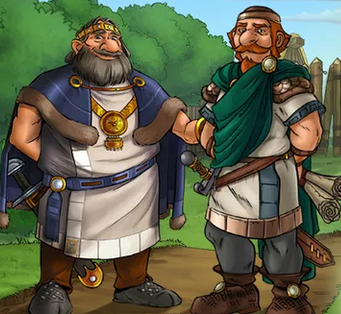 | You can only become a duke through promotion by a king or vice king.
Promotion is reversible. A duke can be demoted back to governor at any time by the king or vice king. |
Dukes are leaders in their own right and have unique mechanics that set them apart from governors.
✅ Can do:
Activate treasuries to collect tributes and generate influence
Collect treasures from raids, robber hideouts, and stolen goods
View troop numbers, crop production, and battle reports from the king and other dukes in the kingdom
❌ Can't do:
Invite and remove governors
Manage diplomacy
Use menhir relocation
Enable vacation mode
Treasures and tributes
As a duke, you can convert one of your hidden treasuries into an active state.
By doing so, the village will generate influence just like a king’s treasury village.
The king and their dukes share information about troops in villages, battle reports, and crop production.
A duke does not generate tributes for the king in villages with an active treasury. Instead, they collect tributes and treasures themselves to expand the kingdom.
Duke villages without an active treasury generate tributes just like governor villages, which can be collected by the king or vice king.
Stolen goods sold by the duke are added directly to the duke’s own treasury.
All treasures from a duke count toward the kingdom’s total treasures and victory points.
For dukes, robber hideouts spawn at only 50 % of the normal speed. This is offset by their ability to collect tribute funds.
Dismissing a duke automatically deactivates any of their treasuries and transfers their treasures to their tribute fund.
The kingdom loses 10 victory points for each active treasure of the dismissed duke.
No victory points are lost if the treasures are inactive.
When a duke abdicates, their duke slot becomes free. Dukes are not automatically replaced. the king must manually promote a new duke if the slot is empty.
A duke attacked by their king will not be removed from the kingdom (unlike other foreign governors).
If a king abdicates, they are automatically replaced by the duke with the highest population in the kingdom.
In a kingdom union: A duke can only be promoted to vice king by the king.
If neither a king nor a vice king remains — for example, after an abdication — the union is automatically disbanded.
A duke cannot enable vacation mode, as it is an active leadership role.
Dukes play a pivotal role in kingdom strategy, acting as regional leaders with their own treasuries and tribute networks. They combine the influence of a leader with the activity of a governor, making them essential for territorial control and treasure collection.
