In Travian Kingdoms, you have the possibility of upgrading villages to cities. Once you have earned enough culture points, you can choose to either found a new village or upgrade an existing one to a city. Cities offer strategic advantages but also come with certain limitations.
A city is an advanced form of a village, created by upgrading an existing village through the Main Building.
While upgrading a village to a city consumes culture points, it does not occupy one of your expansion slots. This makes cities a powerful alternative to founding a new village when you're looking to strengthen your empire.
Requirements to upgrade a village to a city
Before you can upgrade a village to a city, you must meet the following conditions:
Sufficient culture points (The required amount depends on your current expansion stage in the game world.)
Population of at least 500 in the village
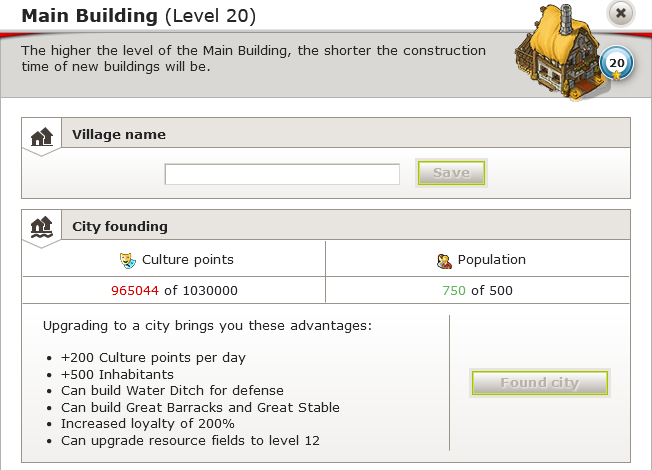
Upgrading to a city provides several notable benefits:
Higher resource field levels: Resource fields can be upgraded up to level 12.
Bonus population: Each city receives 500 extra inhabitants, increasing your influence (important for kings and for oasis).
Increased culture point production:
+500 culture points/day if the capital is a city
+200 culture points/day for other cities
Higher loyalty cap: Maximum loyalty increases to 200%, making cities more resistant to conquest.
Exclusive building: Cities can build a Water Ditch, offering up to 30% defense bonus at level 20.
Harder to conquer: Capturing a city requires the culture points for two villages.
Despite their benefits, cities also have some downsides:
Less expansion flexibility: Founding a new village may be more strategic for expanding territory (for kings) or accessing new oases.
Lower culture point potential: A new village can sometimes outproduce a city in culture points and population over time.
Higher development cost: Building resource fields in a new village is more cost-effective than upgrading existing ones in a city.
Lower overall resource production: Two villages typically produce slightly more resources than one city.
Risk of downgrade: If a city's population drops below 1000, it reverts to a village, and all resource fields above level 10 are reduced to level 10.
No extra queues or feasts: Cities do not provide additional build queues (Barracks, Stable, Workshop) or the ability to hold extra celebration in the Town Hall.
Upgrading to a city is a strategic choice based on your playstyle and priorities. Cities are especially effective for:
Players in high-conflict zones who need better defense and loyalty
Less active players who do not expand aggressively
Maximizing a capital village’s potential in the endgame phase
For well-developed capital villages, upgrading to a capital city is often the optimal move, providing strong defenses and additional culture points without requiring another expansion slot.